
Root vs. Route vs. Rout: What’s the Difference?
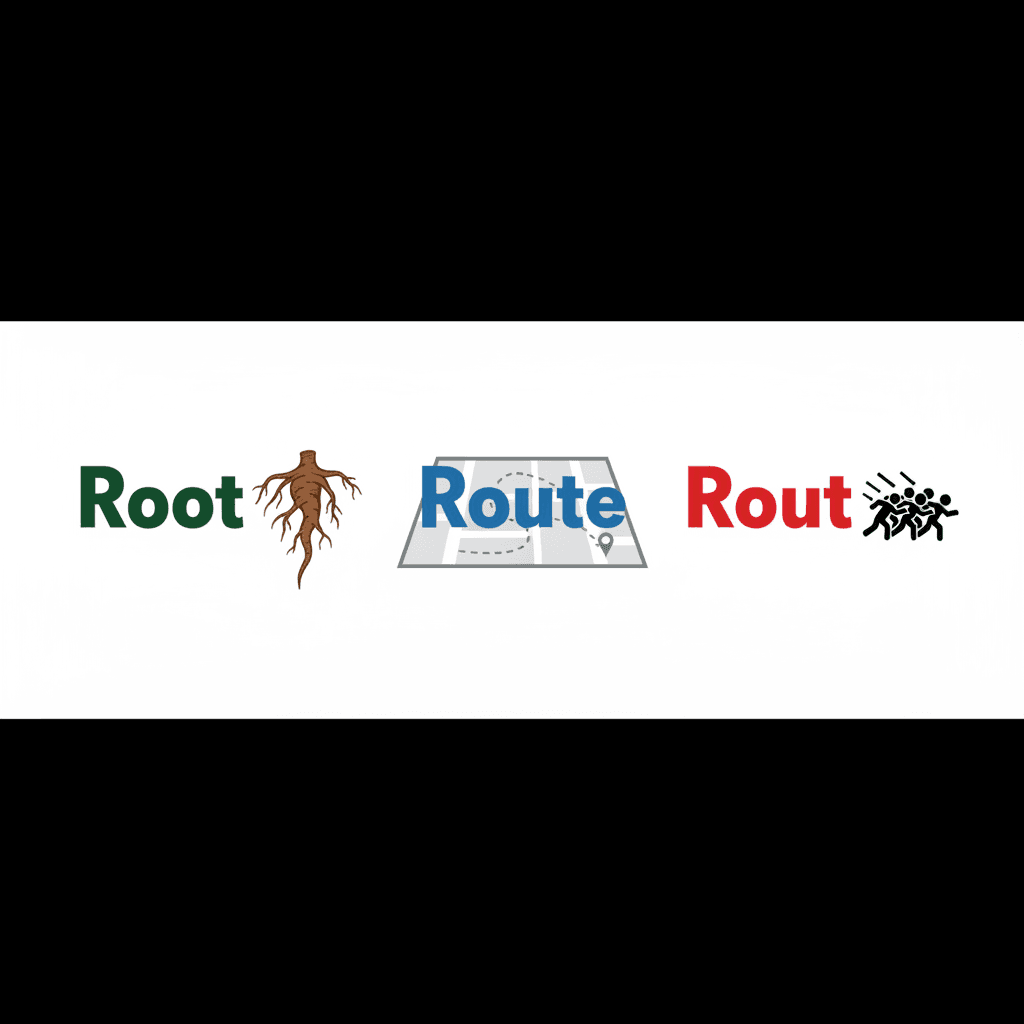 The words root, route, and rout can be confusing because they sound similar — especially in certain accents — but they have completely different meanings.
Here’s the quick rule:
- Root → base or origin 🌱
- Route → path or way 🛣️
- Rout → defeat or disorder 😵
1. Root: The Base or Origin
Meaning
“Root” usually refers to the part of a plant that grows underground, but it can also mean the origin, foundation, or cause of something.
Examples (10 total)
- The tree’s roots go deep into the soil.
- Education is the root of progress.
- Anger was the root of his problem.
- I’m trying to find the root cause of this issue.
- She dyed her hair, but her dark roots are showing.
- The country’s traditions have ancient roots.
- Let’s get to the root of the matter.
- The root folder contains all your files.
- Garlic has strong roots in Mediterranean cooking.
- I can’t root my phone without breaking the warranty.
🧠 Tip:
If it means origin, base, or underground part, it’s root.
2. Route: The Path or Way
Meaning
“Route” means a path, road, or course taken to get from one place to another.
It can also mean a planned method or delivery path.
Examples (10 total)
- This is the fastest route to the airport.
- What route does your bus take?
- We took the scenic route through the mountains.
- The delivery route covers six neighborhoods.
- Our hiking route passes a waterfall.
- The army planned a new route to the city.
- GPS found a shorter route.
- The trade route connected Asia and Europe.
- He’s on the route to success.
- You can route the call to another number.
🧠 Pronunciation Note:
- In American English, route can sound like “rowt” or “root.”
- In British English, it’s usually pronounced “root.”
3. Rout: A Defeat or Disorderly Retreat
Meaning
“Rout” is the least common of the three. It means a disorganized defeat, especially in battle, or a chaotic situation where people flee or scatter.
Examples (10 total)
- The enemy army fled in a rout.
- The team suffered a total rout in yesterday’s game.
- The debate ended in a political rout.
- The soldiers’ rout was chaotic and quick.
- The company’s failure was a financial rout.
- The crowd’s rout caused panic.
- They turned the rout into a surprise victory.
- The invasion ended in a humiliating rout.
- After the rout, the commander resigned.
- The protest turned into a rout as people ran away.
🧠 Tip:
If it means defeat or disorder, it’s rout — with an “ou” like in out, because everything falls out of order.
4. Quick Comparison Table
| Word | Meaning | Example | Memory Trick |
|---|---|---|---|
| Root | Base, origin, underground part | The roots of the tree go deep. | Think 🌱 — where things grow from. |
| Route | Path or way | This is the fastest route to school. | Think 🛣️ — your way or path. |
| Rout | Defeat, chaos | The army’s rout shocked the nation. | Think 😵 — everything’s out of control. |
5. How to Remember
👉 Root — grows in the ground (base/origin).
👉 Route — helps you move (path).
👉 Rout — everything’s out (chaos/defeat).
💡 Memory Trick:
A plant has a root, a traveler takes a route, and an army suffers a rout.
6. Common Mistakes
❌ We took a new root to work.
✅ We took a new route to work.
❌ The enemy suffered a route.
✅ The enemy suffered a rout.
❌ The router tree was growing fast.
✅ The rooter (gardener) planted a tree.
7. Why They’re Easy to Confuse
These words are homophones (or near-homophones) in some accents.
In American English, route can sound like root; in British English, they often sound identical.
Context is key — look at the sentence meaning to choose the right one.
Grammar tools like Humanizey can help automatically detect confusing word pairs like these and suggest the correct one for your writing tone and region.
FAQs
1. Are “route” and “rout” pronounced the same?
In American English, yes — sometimes both are pronounced rowt. In British English, route sounds like root.
2. Can “root” ever mean “cheer for”?
Yes! In American slang: I’m rooting for you = I’m cheering for you.
3. Is “rout” ever a verb?
Yes. To rout (out) means to drive out or defeat completely.
Example: They routed the enemy forces.
4. Is “route” also a verb?
Yes — to route something means to send or direct it along a path.
Example: Please route the email to the manager.
Practice: Choose the Correct Word (“Root”, “Route”, or “Rout”)
(Answers are listed at the end.)
- The army’s defeat turned into a complete ___.
- I’m trying to find the best ___ to the stadium.
- The plant’s ___ grew deep underground.
- The company’s collapse was a financial ___.
- Let’s take the scenic ___ through the forest.
- Education is the ___ of all progress.
- They were ___ed by the opposing team.
- The taxi driver knows every ___ in the city.
- She traced her family’s ___ back to Ireland.
- The troops were forced to ___ after the surprise attack.
Answers
- rout
- route
- root
- rout
- route
- root
- rout
- route
- root
- rout