
Thru vs. Through: What’s the Difference?
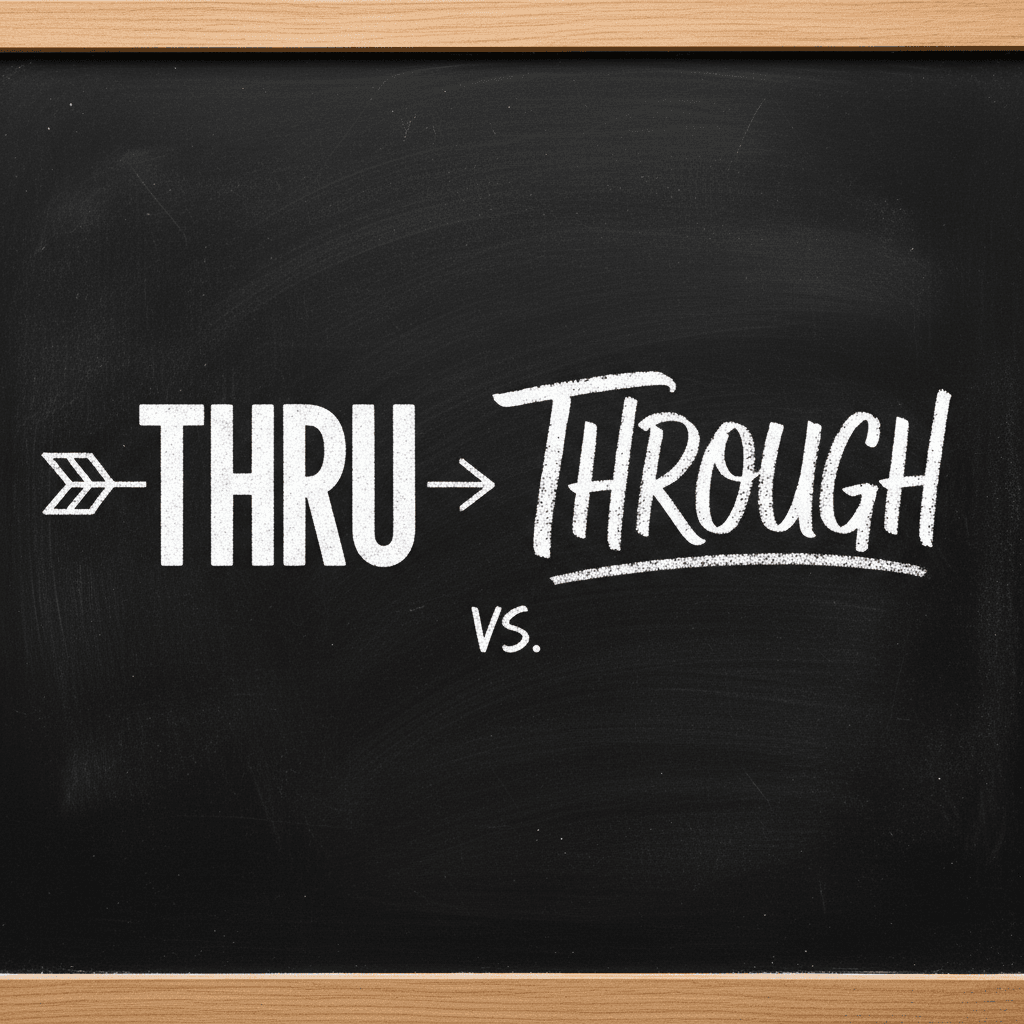 The words thru and through have the same meaning — movement from one side to another — but they differ in formality, spelling, and usage.
Let’s explore how and when to use each correctly.
Through: The Standard and Formal Spelling
Meaning
“Through” is the standard spelling and is used in all formal, academic, and professional contexts.
It can act as a preposition, adverb, or adjective, expressing motion, completion, or connection.
Examples (10 total)
-
We drove through the tunnel.
-
She walked through the park every morning.
-
He read through all the notes carefully.
-
The light came through the window.
-
They worked through the night to finish.
-
We made it through the storm safely.
-
The train goes through several small towns.
-
I got through the exam without stress.
-
The water flows through the pipes.
-
The project went through three approval stages.
🧠 Tip:
Use through whenever you’re writing formally — in school, at work, or in publications.
Thru: The Informal or Simplified Spelling
Meaning
“Thru” is an informal or alternative spelling of through.
It’s mainly used in signs, text messages, and marketing, not in academic or business writing.
Examples (10 total)
- The restaurant has a drive-thru window.
- Text me when you’re thru with class.
- We went thru the checklist quickly.
- She’s already thru her homework.
- The bank offers 24-hour drive-thru service.
- He got thru the presentation with ease.
- Go straight thru the next intersection.
- Thanks for helping me get thru this week.
- We drove thru heavy traffic this morning.
- I’m almost thru reading this book.
🧠 Tip:
Use thru only in casual writing or brand names, like Drive-Thru or Thru-Hike.
Quick Comparison Table
| Word | Style | Common Use | Example |
|---|---|---|---|
| Through | Formal / Standard | Essays, reports, professional writing | He walked through the door. |
| Thru | Informal / Simplified | Texts, signs, marketing | We ordered at the drive-thru. |
How to Remember the Difference
👉 Through = Correct in all contexts
👉 Thru = Only casual or visual shortcuts
💡 Memory Trick:
“Thru” is shorter — just like texting shortcuts.
“Through” is longer — for serious, proper writing.
Why the Confusion?
“Thru” was first popularized by road signs and advertising in the U.S. because it’s shorter and easier to read.
However, dictionaries and grammar guides still recommend through for any formal situation.
Even AI tools sometimes mix them up, which is why Humanizey helps detect and fix informal spellings automatically when you need polished text.
FAQs
1. Is “thru” grammatically correct?
Yes, but it’s informal. It’s fine for texting or signage, but not for essays or reports.
2. Can I use “thru” in business writing?
No. Always use through in professional or academic writing.
3. Why does “drive-thru” use “thru”?
Because it’s shorter and more readable on signs — it’s a marketing choice, not a grammar rule.
4. Is “thru” used in British English?
Rarely. British English prefers through almost exclusively.
Practice: Choose the Correct Word (“Thru” or “Through”)
(Answers are listed at the end.)
- We walked ___ the forest at dawn.
- The restaurant has a 24-hour drive-___.
- She worked ___ the night to finish.
- I’m almost ___ with my report.
- The light came ___ the clouds.
- Go straight ___ and turn right.
- He made it ___ the exam easily.
- We talked ___ all the details.
- The coffee shop opened a new drive-___.
- Thanks for helping me get ___ this tough week.
Answers
- through
- thru
- through
- thru
- through
- through
- through
- through
- thru
- thru